



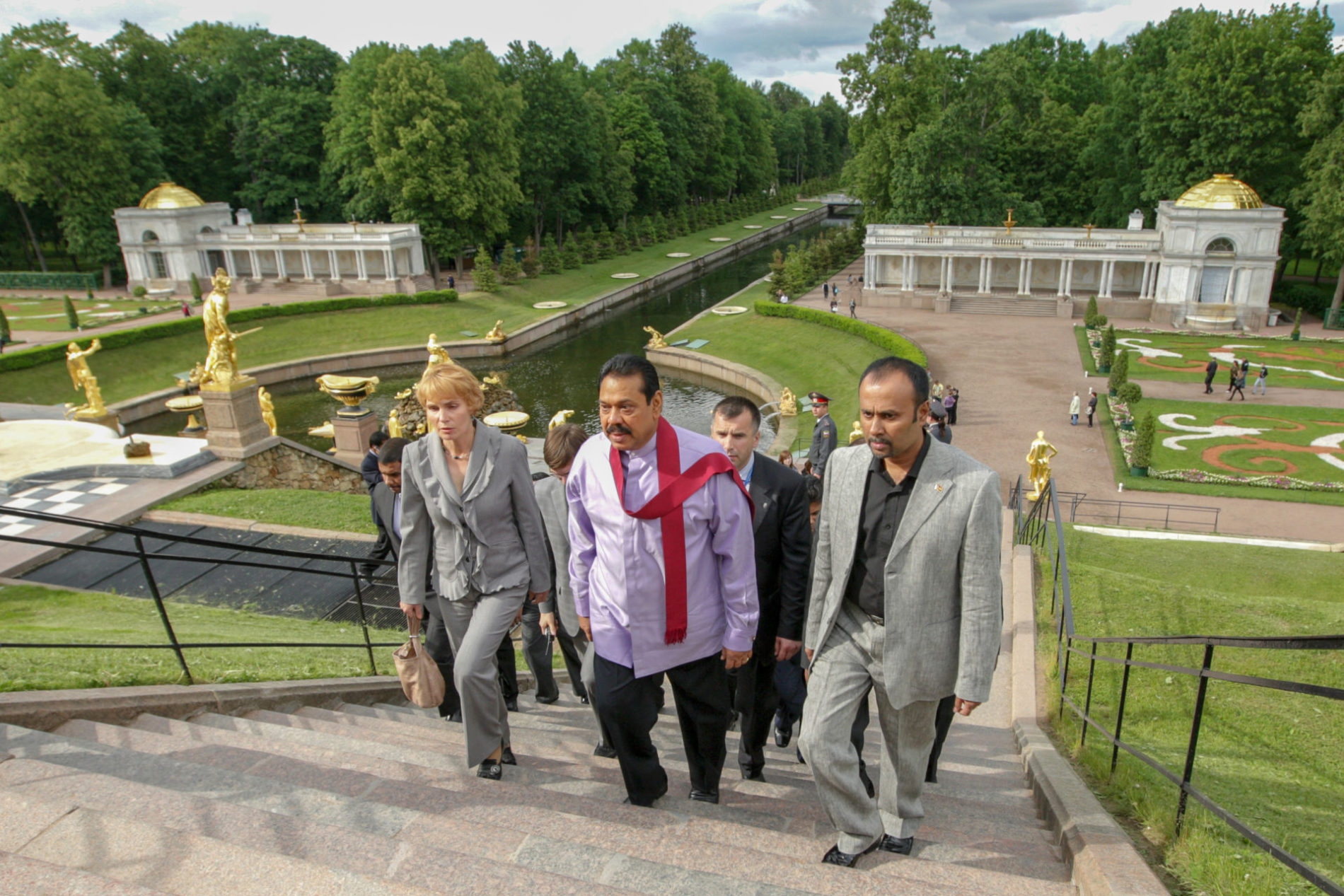
[:en]President visits Hermitage and Petrodvorets
16 & 18th June 2011
President Rajapaksa also visits Hermitage & Peterhof.
State Hermitage
Founded by Tsar Peter the Great on May 27, 1703, Saint Petersburg was capital of the Russian Empire for more than two hundred years (1712–1728, 1732–1918). St. Petersburg ceased being the capital in 1918 after the Russian Revolution of 1917. The collection of the State Hermitage includes more than three million works of art and artefacts of the world culture. Among them are paintings, graphic works, sculptures and works of applied art, archaeological finds and numismatic material. The main architectural ensemble of the Hermitage situated in the centre of St Petersburg consists of the Winter Palace, the former state residence of the Russian emperors, the buildings of the Small, Old (Great) and New Hermitages, the Hermitage Theatre and the Auxiliary House. The museum complex also includes the Menshikov Palace and the Eastern Wing of the General Staff building, the Staraya Derevnya Restoration and Storage Centre and the Museum of the Imperial Porcelain Factory
Peterhof
One of St. Petersburg’s most famous and popular visitor attractions, the palace and park at Peterhof (also known as Petrodvorets) are often referred to as “the Russian Versaille”, although many visitors conclude that the comparison does a disservice to the grandeur and scope of this majestic estate. Versailles was, however, the inspiration for Peter the Great’s desire to build an imperial palace in the suburbs of his new city and, after an aborted attempt at Strelna, Peterhof – which means “Peter’s Court” in German – became the site for the Tsar’s Monplaisir Palace, and then of the original Grand Palace. The estate was equally popular with Peter’s granddaughter, Empress Elizabeth, who ordered the expansion of the Grand Palace and greatly extended the park and the famous system of fountains, including the truly spectacular Grand Cascade. Improvements to the park continued throughout the 18th and 19th centuries. Catherine the Great, after leaving her own mark on the park, moved the court to Pushkin, but Peterhof once again became the official Imperial Residence in the reign of Nicholas I, who ordered the building of the modest Cottage Palace in 1826. Like almost all St. Petersburg’s suburban estates, Peterhof was ravaged by German troops during the Second World War. It was, however, one of the first to be resurrected and, thanks to the work of military engineers and over 1,000 volunteers, most of the estate’s major structures had been fully restored by 1947. The name was also de-Germanicized after the war, becoming Petrodvorets, the name under which the surrounding town is still known. The palace and park are once again known as Peterhof.
[ngg src=”galleries” ids=”82″ display=”basic_thumbnail”]
Добро пожаловать в летний Санкт-Петербург!
Добро пожаловать в летний Санкт-Петербург!Холодной зимой пусть нас согреют кадры летнего Питера!)
Posted by Русский медведь / Russian Bear on Wednesday, January 9, 2019
[:ru]Визиты президента на Эрмитаж и Петергоф
16 & 18 июня 2011
Президент Раджапакса также поситил Эрмитаж и Петергоф.
Государственный Эрмитаж
Основанная Петром Великим 27 мая 1703, Санкт-Петербург был столицей Российской империи на протяжении более двухсот лет (1712-1728, 1732-1918). Санкт-Петербург перестал быть столицей в 1918 году после революции в России 1917 года коллекция Государственного Эрмитажа включает в себя более трех миллионов произведений искусства и артефактов мировой культуры. Среди них картины, графические работы, скульптуры и произведения декоративно-прикладного искусства, археологические находки и нумизматический материал. Главный архитектурный ансамбль Эрмитажа, расположенный в центре Санкт-Петербурга, входят Зимний дворец, бывший государственной резиденции российских императоров, здания Малого, Старый (Великий) и новых Эрмитажей, в Эрмитажном театре и Запасной дом , В музейный комплекс также включает в себя Меншиковский дворец и восточное крыло здания Главного штаба, Старая Деревня Реставрация и хранение центр и музей Императорского фарфорового завода
Петергоф
Один из самых известных и популярных туристических достопримечательностей Санкт-Петербурга, дворца и парка в Петергофе (также известный как Петродворец) часто называют «русской Версаль», хотя многие посетители заключить, что сравнение делает медвежью услугу величия и объема этого величественного поместья. Версаль, однако, источником вдохновения для желания Петра Великого, чтобы построить императорский дворец в пригороде своего нового города и, после неудачной попытки в Стрельне, Петергофе — что означает «суд Петра» в Германии — стал местом для царской Монплезир, а затем оригинального Большого дворца. Поместье было одинаково популярны с внучкой Петра, императрицы Елизаветы Петровны, который приказал расширение Большого дворца и значительно расширенной парк и знаменитую систему фонтанов, в том числе поистине впечатляющим Большого каскада. Улучшения в парке продолжалась на протяжении 18 и 19 веков. Екатерина Великая, после чего ее собственную марку на парк, переехал суд Пушкина, но Петергоф снова стала официальным императорской резиденции в царствование Николая I, который приказал здание дворца скромным Cottage в 1826 году, как почти все пригородные имения Санкт-Петербурга, Петергоф был разорен немецкими войсками во время Второй мировой войны. Было, однако, одним из первых, чтобы воскреснуть и, благодаря работе военных инженеров и более 1000 добровольцев, большинство из основных структур усадьбы были полностью восстановлены в 1947 году название было также де-Germanicized после войны, становится Петродворец, имя, под которым окружающие город все еще неизвестно. Дворец и парк вновь известный как Петергофе.
[ngg src=”galleries” ids=”82″ display=”basic_thumbnail”]
Добро пожаловать в летний Санкт-Петербург!
Добро пожаловать в летний Санкт-Петербург!Холодной зимой пусть нас согреют кадры летнего Питера!)
Posted by Русский медведь / Russian Bear on Wednesday, January 9, 2019
[:SI]President visits Hermitage and Petrodvorets
16 & 18th June 2011
President Rajapaksa also visits Hermitage & Peterhof.
State Hermitage
Founded by Tsar Peter the Great on May 27, 1703, Saint Petersburg was capital of the Russian Empire for more than two hundred years (1712–1728, 1732–1918). St. Petersburg ceased being the capital in 1918 after the Russian Revolution of 1917. The collection of the State Hermitage includes more than three million works of art and artefacts of the world culture. Among them are paintings, graphic works, sculptures and works of applied art, archaeological finds and numismatic material. The main architectural ensemble of the Hermitage situated in the centre of St Petersburg consists of the Winter Palace, the former state residence of the Russian emperors, the buildings of the Small, Old (Great) and New Hermitages, the Hermitage Theatre and the Auxiliary House. The museum complex also includes the Menshikov Palace and the Eastern Wing of the General Staff building, the Staraya Derevnya Restoration and Storage Centre and the Museum of the Imperial Porcelain Factory
Peterhof
One of St. Petersburg’s most famous and popular visitor attractions, the palace and park at Peterhof (also known as Petrodvorets) are often referred to as “the Russian Versaille”, although many visitors conclude that the comparison does a disservice to the grandeur and scope of this majestic estate. Versailles was, however, the inspiration for Peter the Great’s desire to build an imperial palace in the suburbs of his new city and, after an aborted attempt at Strelna, Peterhof – which means “Peter’s Court” in German – became the site for the Tsar’s Monplaisir Palace, and then of the original Grand Palace. The estate was equally popular with Peter’s granddaughter, Empress Elizabeth, who ordered the expansion of the Grand Palace and greatly extended the park and the famous system of fountains, including the truly spectacular Grand Cascade. Improvements to the park continued throughout the 18th and 19th centuries. Catherine the Great, after leaving her own mark on the park, moved the court to Pushkin, but Peterhof once again became the official Imperial Residence in the reign of Nicholas I, who ordered the building of the modest Cottage Palace in 1826. Like almost all St. Petersburg’s suburban estates, Peterhof was ravaged by German troops during the Second World War. It was, however, one of the first to be resurrected and, thanks to the work of military engineers and over 1,000 volunteers, most of the estate’s major structures had been fully restored by 1947. The name was also de-Germanicized after the war, becoming Petrodvorets, the name under which the surrounding town is still known. The palace and park are once again known as Peterhof.
[ngg src=”galleries” ids=”82″ display=”basic_thumbnail”]
Добро пожаловать в летний Санкт-Петербург!
Добро пожаловать в летний Санкт-Петербург!Холодной зимой пусть нас согреют кадры летнего Питера!)
Posted by Русский медведь / Russian Bear on Wednesday, January 9, 2019
[:]